Monday, 24 October 2016

The Sore Loser

What is it that I don’t like about Jeremy Corbyn? (October 2016)

At the beginning, I was a Corbyn supporter, so my political tendencies are closely aligned with his. Nevertheless, I believe that his re-election as Labour leader will consign the party to the political wilderness for a decade or more. Since I like his politics, I have to ask myself “why am I so convinced of this?” It does not make obvious sense.

The June EU referendum in which the UK voted to exit from the European political block represents a second strand to this argument. To date I’ve always tried to keep these issues separate, but they are so closely intertwined I don’t think I can make sense of the whole unless I treat them together.

We know the bare facts of the history. Corbyn was elected the Labour Party leader following electoral defeat at the 2015 general election. The Tory Party had promised a referendum on membership of the EU if it won the election. It delivered on that promise. As individual streams of reality there is nothing particularly remarkable but together they have the power to decimate the future of the UK. Why? Because, it leaves no one to speak for the 48% who voted to stay in the EU.

The argument from the Brexit camp seems to be that I and 16 million or so fellow voters were on the losing side so we should put up and shut up. In a normal General Election I would indeed agree, but this was not a normal election. I do not get to vote again in five years’ time.

A further argument might run that I should leave it to our MPs. After all, that’s what they were elected for. Our current Prime Minister, Mrs May, seems to believe that the referendum vote provides her with all the authority she requires to proceed without further scrutiny from Parliament. In fact there has been a wholesale changing of the guard in Her Majesty’s Government (HMG). Was this really a vote to change HMG? Yet that is what has happened. Not only have the personnel changed but significant tranches of government policy have changed. The referendum was not a general election. It conferred no such authority upon the government post referendum, no matter how plausible and rational the changes she proposes. Yet in reality that is exactly what has happened.

At this point, I feel the need to step back again and take a long hard look at what really happened in the context. The members of the UK electorate were given an opportunity to voice an opinion on whether we should remain part of the EU. I’m satisfied that for 90% of the electorate, who voted that is exactly what they did. But I’m not convinced of the remaining 10%. The scope and integrity of the arguments laid before the electorate on both sides lend credence to this view.

The narrowness of the scope of the arguments laid before us and in some respects their downright mendacity suggests that we were being duped for the sake of winning the vote. A feeling of being duped, I suspect was quite widespread and at least some part of the electorate was determined to make their voices known. Is this fanciful thinking on my part? I suspect not. Railing against the government of the day is common place, especially in by-elections.

I have analysed the votes against the government in by-election over the past 4 general election periods. These analyses show a clear protest against the government of the day between general elections. Data source http://www.politicsresources.net/area/uk/edates.htm


These tables show clearly that protest against the government of the day is a common feature of by elections, but the sentiment tends to be reversed in General Elections. 

It would be prudent for any government to consider whether this kind of sentiment had affected the result of the referendum. The Cameron administration had invited some pre-eminent voices from the international scene to speak on its behalf. For voters, already predisposed to protest, this could have confirmed their prejudices.

A potent argument against this logic could be that the referendum was a “single issue” topic and therefore not susceptible to the kind of protest so clearly exhibited in by-elections. In truth though this apparently simple question has a multitude of facets. Indeed it is so easy to get lost in the myriad of detail that comprises the EU, I wonder why it was ever considered suitable for a national plebiscite. For that I would have to look into the minds of those who prepared to the 2015 Tory manifesto. This is a task I am determined to avoid.

Unlike our history of by-elections, there is no evidence from similar elections to demonstrate that this was a protest vote. However, I note from Polly Tornbees’s article in the Guardian, 20 October, that the level of regret amongst leave voters was significant around 6%. The equivalent level of regret amongst remain voters (at not being on the winning side) was 1%. On this basis the result of the referendum would have been reversed.

Nevertheless, we have a result that say that the UK should seek to extricate itself from the EU. The new Tory administration is determined to follow the referendum commendation without further consideration. So how should the 48% who voted to remain in the EU react?

Normally, one would jump on the opposition bandwagon and wait for the next general election. This is not practicable. Firstly, the leader of the Opposition (one Jeremy Corbyn) won’t oppose leaving the EU, even though he “said” he was in favour of staying. Secondly, we the electorate, don’t get the chance to reverse the decision in 4 or 5 years’ time.

The “remain campaign” cannot bury its collective head in the sand. It must act now, but how. We desperately need a collective opposition to Brexit. In the absence of Jeremy Corbyn stepping up to the mark, he must be disposed of, since his presence is a positive barrier to effective opposition.

Let us suppose then, that the Parliamentary Labour Party would once again approve a vote of no confidence in Mr Corbyn. That would leave the PLP both leaderless and exhausted from a bruising leadership election over the summer. My advice would be to appoint a caretaker leader until next year’s conference season. That would still leave the “remain campaign” without a focal point or leader.

Curiously, we have a ready-made leader in Nicola Sturgeon of the SNP. Her voter base may appear out on a limb in Scotland, but she is experienced and effective. I wonder if she would be prepared to lead a coalition of that rather disparate opinion that represents the “remain campaign”.

Tuesday, 18 October 2016

A Question of Timing

Quite often I’m alone on my morning walk and my mind has a tendency to wander. On this particular morning I wondered whether there was a clear relationship between the number of steps taken on the walk and the time taken. Of course, I had recently bought a stopwatch and was anxious to get good use out of it.

A moments pondering suggested that there would be an inverse relationship between number of steps and speed. I had measured the distance of our morning walk fairly carefully (see Measurement) so calculating speed was easy. By this time, I thought I’d enough data to evaluate whether there was indeed a correlation.

Excel is not regarded as a good statistical package, but it’ll do for my amateurish approach. I have 26 data points ranging from 5462 steps to 5846 at the high end.

Data points from my Morning Walk
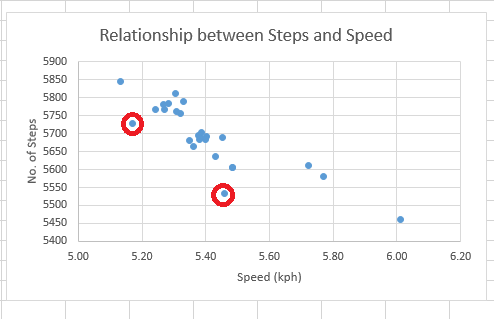
When plotted on a scatter graph it gave a good impression of verifiable statistical relationship.


I have marked two data points that might be regarded as outliers. The problem with outliers is that I really have to justify their classification. Fortunately I maintain a contemporaneous commentary on the morning walks and both these data points had suitable remarks. These remarks provided the justification for their removal from the data set.

Looks may not be everything, but in this case the scatter graph provides a much more convincing case for a correlation between speed and the number of steps.


In fact in statistical terms the correlation coefficient improves from -0.85 to -0.90.

Friday, 14 October 2016

A New Morning Walk Route

On Tuesday, Bryony and I set out for our regular morning walk in aid of getting fit, or at least fitter. The route goes down the gentle slope of the Needham Road out of Harleston. We then turn right into Starston Lane. This has a dip in the road from which water cannot escape and a rather steeoer slope the other side of it – see the gully at the start of Starston Lane (Walking, talking and listening). The dip was completely flooded filling the whole road. There was no route to either side. We gave up and returned home.

Since winter is coming on and we are likely to face more occasions when we cannot use this route. I was determined to find a new route, roughly equivalent to this one.

I first sought to circumvent the gully. This is possible by continuing on towards the roundabout and turning right along the side of the Needham bypass. There is no footpath here but plenty of fairly flat grass. In 200 - 300 yards we reach a footpath (also not paved) going back to Starston Lane.

Adjusting the usual Starston :Lane route
While this isn’t a major diversion, the lack of paved walking is a major drawback. This is not a long morning walk. The only way it can deliver a reasonable contribution to an exercise regime is by taking it reasonably quickly. As winter draws in and the mornings become darker, there is no chance of maintaining a reasonable speed over this portion. Sadly, this route has to be rejected.

I’ve always liked the route to Harleston’s sister community in Redenhall. This has the advantage that it can all be walked on paved roads, which are, mostly, free of traffic.

Route via Redenhall and the Gawdy Hall Estate
There are however some major drawbacks. It crosses the main A143 twice, which means waiting for a gap in the traffic. It is also about 4.3 miles long. This is too long for a morning walk which has to be fitted with our commitments as grandparents. A pity, I liked this route.

The advantage of the north eastern end of town is that it exhibits far fewer steep slopes, so the tendency to get flooded is also reduced. After heavy this also seems a good alternative. The major issue was to find a route that was roughly equivalent to the distance of the Starston Lane route, kept to paved roads and which was relatively free of traffic. Eventually I chose a route as shown below.

Route via School Lane and Lush Bush 

It proved to be a couple of hundred yards longer than the Starston Lane route, but we encounter slightly less traffic. The timings are very similar.

Friday, 7 October 2016

Spreadsheet Control Strategies and Tactics

The majority of spreadsheet users/builders never consider the methods of controlling spreadsheets as a separate entity to the functions of the spreadsheets themselves. A minority do consider controls and employ a variety of tactics (e.g. protecting cells, hiding sensitive/rows columns, hiding a sensitive worksheet, employing named elements, employing specialised structure (like Excel tables)). I have yet to see this given strategic consideration at the beginning of the construction process.

The purpose of this article is to seek to persuade readers that in addition to these elements (the primary functions and the control methodologies) the context and environment in which a spreadsheet exists is equally as important. This context should be considered separately at a strategic level. This context will have a profound impact on the way we build spreadsheets in terms of structure and the life span of any individual spreadsheet system.

Background – an auditor’s perspective

In traditional management systems, we were able to separate clearly the functional role of the system and the controls associated with the system that ensured it operated correctly. We employed simple control mechanisms such as the separation of duties and validation of calculations by cross tabulation. In extremis I came across one early computerised farm subsidy system (circa 1980s) where entries were validated by double entry; the entries were posted by two different operators and the system validated that both sets of entries were the same. Since then, cheap effective computerisation has changed both the systems and the landscape within which controls operate hugely. How should we manage this change?

In nature, the functional systems and the controls that maintain the functional systems are so closely integrated we tend to treat them as a single system. The relationship between a biochemical system and its related enzymes are such, that it is almost impossible to describe the chemistry of the pathway without incorporating a description of the role of the enzyme. Similarly the relationship between a computerised management system and the enzyme like nature of the controls need to be teased out.

When I think of a computerised management system, it’s not usually a spreadsheet or even a system of connected spreadsheets. Rather it is a combination of related activities where managers, operators and the computerised system combine together to achieve some useful outcome. It is only rarely that a (system of) spreadsheet(s) is considered part of the management system and is recorded as such.

Recently some emphasis has been given to identifying the “important” spreadsheets within an organisation, so as to ensure that they are monitored and controlled properly. In my view this is the equivalent of putting the cart before the horse. It is the horse (or the functional system) that should be doing the pulling.

The Relationship between Spreadsheets and other computerised systems

Ask yourself the question “how often do spreadsheets really exist on total isolation?” In my case the answer is never, but as a general rule an assumption of almost never is pretty safe. Does it matter then that the inputs come from somewhere else and that the outputs go to somewhere else? In my view, yes, and the rest of this section is devoted to an explanation.

Spreadsheets may indeed be ubiquitous, but that does not mean that they can or should do everything. While there are some effective comprehensive spreadsheet systems in the accounting and business control environment, these are the exception rather than the rule. However, there is one lesson I’d like to draw from the accounting environment. Every figure in the income and expenditure ledgers is verifiable to an independent source. In fact this sense of verifiability extends to every figure posted into the accounting system, albeit not necessarily from an income or expenditure voucher.

So if a spreadsheet is only part of a system, part of the discipline of creating a process/calculation that is internally consistent is to specify where the inputs came. If necessary, this means that they can be checked. In my own experience it is very useful to have hyperlinks to the original sources. It saves potentially hours of argument.

I accept that where there are a large range of sources creating connections to each source can be tedious. But the counterargument is that; the wider the range of sources the greater the opportunity for errors to creep in. Verifiability is essential. The quicker and easier it is to verify a particular figure the better.

Indexing sources of information

As a general rule, the outputs from a spreadsheet are for the owner to handle and to use as he or she sees fit. One might therefore argue that as the owner she or she is under no obligation to show how the results are used. 

As an auditor I would argue that this an unrealistically narrow perspective. The spreadsheet is part of an overall system. Of course the owner of the overall system should maintain an overview of how it operates. It is up to the individual to decide the level of detail that overview should take. My opinion is that each spreadsheet should state explicitly where the results should be used and by whom. This detail would help give information about scope of validity of the results and their durability.

Tactics for Defining Relations between Operational Systems and Spreadsheets

There is no universal method for defining the context in which any individual spreadsheet exists. Indeed from my own audit perspective, context is nearly always depended on who told me that a particular spreadsheet existed and why it had been created. It was very rare that I could go to a spreadsheet file and find out from within it why it existed. While this is certainly the generally accepted method of handling spreadsheets, I consider that it is open to question whether this has ever been satisfactory.

Spreadsheets are independent artefacts that rarely form part of an integrated system that is controlled from the centre by the “systems controller”. Therefore spreadsheet creators must develop a methodology that can be easily followed by new user as to the context in which it exists. Once again some of the more advanced software for spreadsheet accounts/financial systems provide indexes and links that help set the context, but this is far from universal.

Where next!

Typically, I have developed my own methodology for allowing spreadsheet users to set the context of a spreadsheet system within a controlled environment. But what it is needed is education of creators and users to be explicit about where their data is coming from and where the results are going to be
used.

Monday, 29 August 2016

Arrays vs. Arrayformulae

I find myself having to defend my intense dislike of Excel's array formulae methodology. Since I’m no expert in this aspect of Excel, this consideration relies upon Chip Pearson’s advice.

In reality, most familiar Excel formulae use arrays like =SUM(A2:A4). In this case the formula instructs Excel to sum all the values in the array of cells {A2, A3, A4}. In fact the formula = SUM(A2, A3, A4)  performs exactly the same task as =SUM(A2:A4).  Excel is also quite happy mixing different forms of presentation such as =SUM(A2:A4, C5:C20, D1:D2). In short Excel is pretty clever at interpreting user requirements.

Array formulae are different and the user must give Excel a specific instruction for the software to handle the instruction correctly. This takes the form of curly braces around the formulae {} generated by posting the formula using Control, Shift and Enter.

Chip offers the example of {=AVERAGE(IF(A7:A13>0,A7:A13,FALSE))}. Interpret this in plain English as for each element in the array A7:A13, if it is more than zero include it is the average otherwise leave it out (FALSE). The curly braces are absolutely crucial to this interpretation. Here is the evaluation of this formula with the curly braces in place.

See cell B7 for the result 5.25
On the other hand the identical formula, if posted using Enter it delivers the following result. This is a standard average.

See cell C7 for the result 2.142857


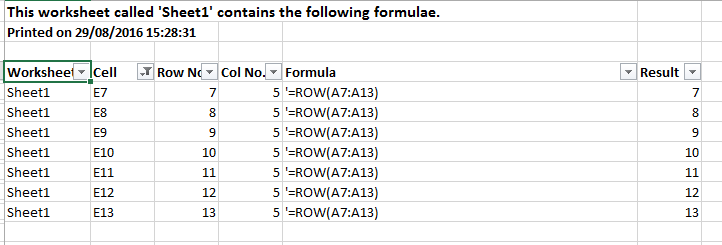
Even more confusing, if you list the formulae in your worksheet by evaluating each cell for its formula you get the following. Here it looks as if the identical formula cell delivers different results, because formula is never listed with its curly braces.


To me this was sufficient to put me off ever using an array formula, but in reality this is the more simple methodology. 

You can use array formulae to deliver an array of answers. The spreadsheet below has identical formulae in each of cells in columns E {=ROW(A7:A15)} and similarly in column  F {=A7:A13}. However, because they are entered using the control, shift method each cell delivers a different answer appropriate to its position in the array.

 
Arrayformuylae answers delivered according to their position in the array
If, you list the formulae however it is not possible to tell that these have been array entered – as shown below. The user or a reviewer has to deduce the array entry methodology based on the number of identical formulae which deliver different answers.


In each of these cases the identical formula appears to delivers a series of different answers
In all other languages that I have used, it has always been immediately obvious when working with arrays. It simplifies matters both for the user and the auditor. 

No matter how technically clever Excel’s array formula methodology, I will always avoid it if I can.


Walking, talking and listening

Our morning walk is intended as exercise as well as pleasure. I confess the mere act of walking is a pleasure. I don’t need much else, but this is a joint venture. Bryony occasionally reminds me as I lurch in front of her. A little conversation between us is ‘de rigeur’.

The sidewalk out of Harleston down to the Needham roundabout, however is definitely single file. (Please excuse the Americanism but it is a much better description of a path beside a road, than the more conventional footpath.) The traffic coming up from the roundabout tends to put pay to any but traffic related conversation.

By the time we got to the turn off to Starston Lane, and I had set the lap time on my newly acquired all singing, all dancing sports stop watch, Bryony was mildly irritated. She showed this by walking behind me rather slowly. This is a sure sign. Bryony’s longer legs normally have me working hard to keep up with her on this gentle slope. This is a shaded shallow gully and we have to keep our ears alert for vehicles coming behind us. The gully opens out after a couple of hundred yards.

Inevitably, we keep on listening for vehicles; the articulated chicken shit trucks are very big indeed. But once out in the open we hear a lot more. My directional hearing is pretty naff and I don’t think Bryony’s is much better. So we can’t work out whether it’s from the road behind us or over the valley until it is fairly close. I determined to look at the layout in three dimensions using the Ordnance Survey maps contour lines.

Gully at the start of Starston Lane

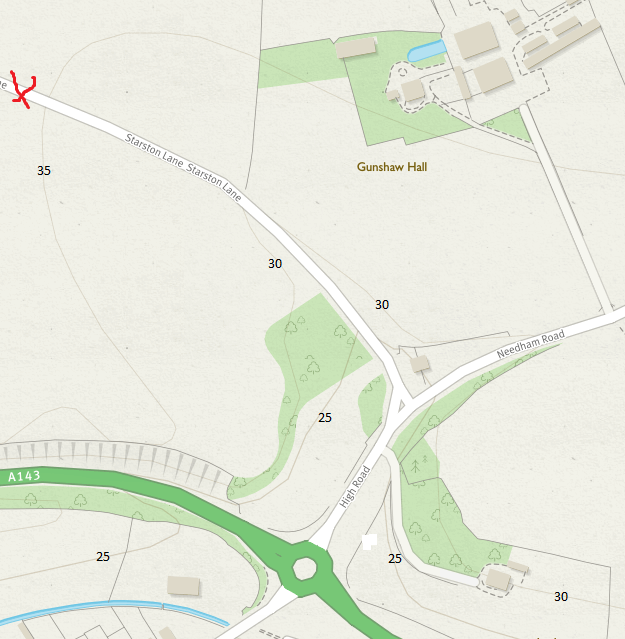
The gully starts at the triangular junction between High Road, Needham Road and Starston Road on the map above.

By the time we reach the squiggly red cross, the gully has opened out and the sounds of vehicles are coming over from the Harleston bypass (marked A143 east of the roundabout). It is difficult to be sure of the exact direction from which the sound is coming. You will notice though, that there is a small copse of woodland and a dwelling surrounded by trees I suspect that this protects us from vehicle noise coming the bypass to the west of the Needham roundabout.

Once round the bend, the country on either side of Starston Lane opens up even further. This year the field to the west are being used by Wharton’s as rose nurseries while to the east the fields are planted to cereals (not rape this year thank goodness). We are both sure that we can hear traffic coming from both directions.

The map below, at a slightly larger scale, shows clear lines of hearing both from the east and the west along the A143. This is the case only once we’ve walked through the long right angled bend in Starston Lane and are heading along the straight towards Cranes Watering Farm.

Towards Cranes Watering Farm. Can hear traffic from both east and west.

Contour Lines

It is difficult to see contour lines from images of OS maps. This problem is exacerbated by the fact that contours are considered less important than other information on the map. Accordingly, if there is a road or a boundary of any sort that always takes precedence. It is not always easy to match up broken contours. 

Contour lines just about visible

Also the online version of the OS map does not appear to give any heights for its contours. The image above shows a series of contours, where I have marked in the heights values, taken from the paper version of the same area.

Paper version showing contour heights


I had to follow these contours through to Starston Lane, to mark the map images above. I still can't be sure that they are correct.

Thursday, 25 August 2016

Tea time music at the Pennoyer Rooms

Friends can be extraordinarily generous. For the past 25+ years Sandra Holmes has loaned me one of her violins. Here is a review of a series of chamber groups who performed for a tea time audience at the Pennoyer Rooms, Pulham St Mary. Sandra performed with two of the groups.

The Pennoyer

Pennoyer Review

The Haydn Op 20 quartets are also known as the Sun quartets, as if they were the dawn of an entirely new genre of music making. Truth be told they weren’t entirely new but they did show off, for the first time, the sophistication of the string quartet form.

This set comprises 6 quartets and No. 4 is undoubtedly the most popular. It is a happy spritely quartet and needs to be played with speed and elegance. This came over well in the outer movements, although there were times when I wanted to push the tempo along. The slow movement is a series on variations which have some brooding elements. These need absolute harmonic clarity. The occasional fudged intonation meant that some of the underlying menace was lost, but the lighter variations came over very well.

The string sextet delivers a special sound to the listener. It is quite different to that of a quartet with a softer, more plangent delivery. It also means that audiences talk over it. I was not close to the players but the little I heard of the Teleman was very pleasing.

The Mozart “Grande Sestetto Concertante” took me by surprise, even though it was written into the programme. Here the medium of the string sextet really came into its own. This very familiar piece (as a violin/viola concerto) took on an entirely new life. It worked exceptionally well in the context of the background murmur of the audience. Next time I’ll get closer.

The oboe quartets seemed to take me back to a previous life. The Mozart oboe quartet was one of the very first long playing records my father bought in the 1960s. It was a delight to be reminded of those days. Even the Stamitz and Vanhal quartets were those that I had known and played (as a violinist) over two decades ago. These performances were well worth the wait.

In the Chapel end of Pennoyers, we heard Mozart’s “Kegelstatt” trio for the unusual combination of piano, clarinet and viola. Typically Mozartian, it is quite unique in the repertoire. The opening Andante is indeed beautiful, but mainly a vehicle for the clarinet to show off. Mike Bishop accomplished this admirably. I’m used to the minuet movement being light hearted, frothy and not too difficult. Not so here. The viola’s triplets are fiendish. Sandra handled these with real dexterity, but at the cost of a tiny reduction in tempo. The final rondo brought us back to normality. The players relaxed and let their hair down (metaphorically speaking of course).

The Schumann Fantasiestücke for clarinet and piano (Op. 73) was a complete surprise. The music was entirely new to me. It certainly gave Richard Donmall the chance to demonstrate the flexibility of his electronic piano. Both he and it were very good indeed and was Mike on clarinet. This is a piece of music I will certainly be acquiring in the near future.


For those interested, the full programme is listed below
While this has nothing specifically to do with a stroke, keeping oneself active and motivated is still part of the recovery process.